

How fashion season planning works, from the numbers to the drop
A fashion season is planned top down and bottom up at once. The financial plan says how much to sell, at what margin and with how much stock; the line plan turns that into slots by category, price and drop; design fills the slots; and a time and action calendar works each style back from its in-store date.

Myth or fact?
Myth: Planning starts with design.
Fact: It starts with numbers. The financial plan and the open-to-buy decide how many options a category can carry at which prices, and design is briefed to fill those slots.
Myth: One calendar fits every style.
Fact: A printed shirt with developed trims and a garment wash needs weeks more than a plain tee in a stock fabric. Good planners give each style its own calendar, worked back from its own date, and watch its critical path.
Myth: Forecasts are only guesses.
Fact: A forecast built on last year's sell-through, store clusters and size curves, with part of the buy held back to chase what sells, turns a guess into a range of outcomes the plan can live with.
1. The financial plan
Planning begins with sales, margin and stock by month or week, by category and channel, built from last year and the trend. It is usually agreed in versions, approved by someone other than its author, and reforecast as the season trades. Open-to-buy falls out of it: what is left to spend once stock and orders are counted.
2. The line plan and the assortment
The line plan turns money into slots: how many options in each category, at which price points, in how many colours, for which store clusters, and in which drop. Each slot has a target cost, which is where the price a supplier can be paid first appears.
Range reviews then walk the line: sketches, samples and costs against the slots, with styles added, dropped or carried over until the range is locked.
3. The time and action calendar
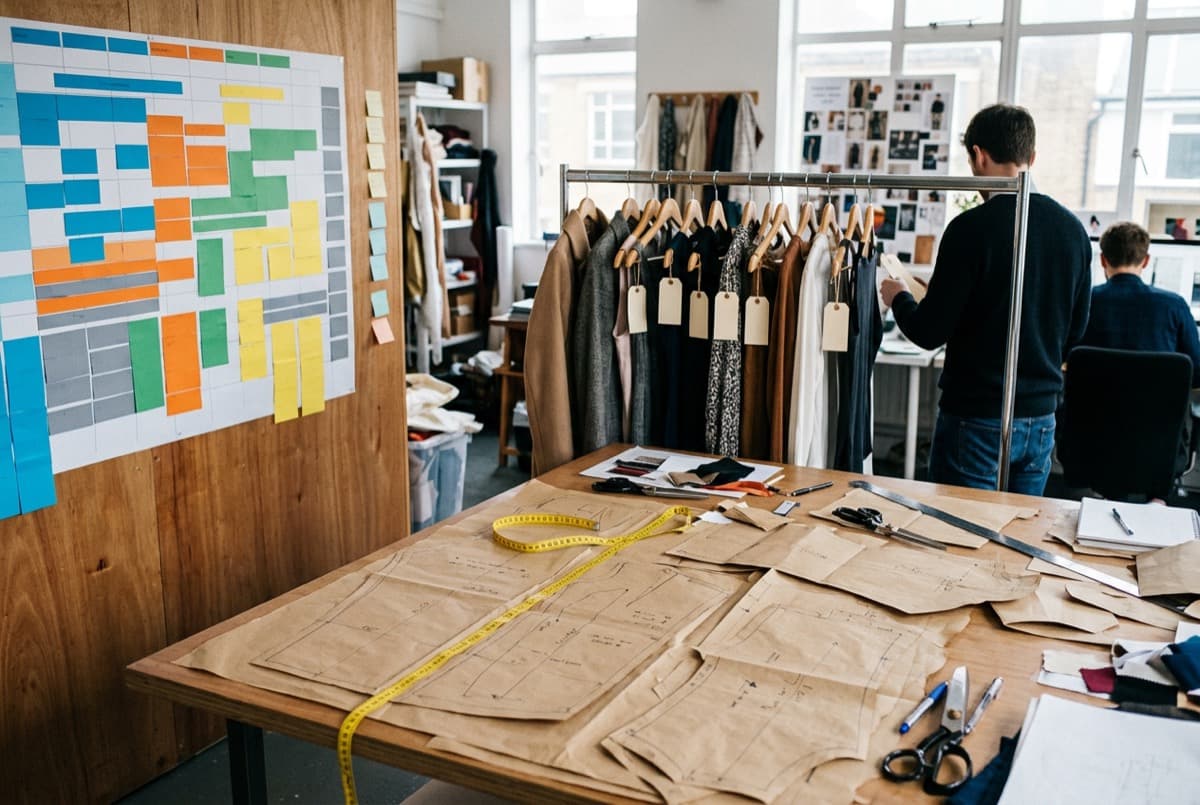
Each style is planned back from the day it must be in store: shipping, ex-factory, production, the pre-production sample, fabric and trims, the fit and proto samples, the tech pack. The chain of steps with no slack is the critical path, and it is the one to watch.
Lead times vary with the product. Fabric developed to order, prints and yarn-dyes, developed trims and garment washes all lengthen the calendar; stock fabrics and repeated styles shorten it.
- Tech pack issued
- Proto and fit samples approved
- Fabric and trims booked
- Pre-production sample approved
- Production and inspection
- Ex-factory, transit, in store
4. The buy
Quantities are set by cluster and store, then split by size using each category's size curve, often packed into ratio packs. Many retailers commit part of the buy up front and keep the rest open to chase the lines that sell.
5. In season and the next plan
Once the line lands, sell-through, weeks of cover and margin drive the moves: chase, move stock between stores, or mark down. What sold and what did not becomes the starting point of the next season's plan.
The words, in plain terms
- Line plan
- The season's plan of options by category, price point, colour and drop, before styles are designed.
- Drop
- A group of styles that arrive in store together on a planned date.
- Time and action calendar
- A style's or order's steps from tech pack to store, each with a planned date worked back from the in-store date.
- Critical path
- The chain of steps with no slack: any delay on it moves the in-store date.
- Size curve
- The share of a style's quantity bought in each size, from what sold before.
Work it out, free
On WOVENN
PLANX
Plan the season, buy to it, and keep every store in stock, on the same records as design and sourcing.
See PLANXKeep reading

Retail · Planning · Costing
How fashion retail makes money: mark-up, markdowns and sell-through
Initial mark-up, landed cost, markdowns, sell-through, weeks of cover and open-to-buy explained, with the myths about doubling the cost and selling out.
7 min read · 3 myths bustedRead

Planning · Retail
Open-to-buy explained: how buyers know how much to buy
How open-to-buy is worked out from planned sales, markdowns and stock, at retail and at cost, and how sell-through and cover tell a buyer when to act.
5 min read · 3 myths bustedRead
Costing · Retail
FOB, landed cost and margin: how a garment's price is built
How a garment's cost builds from fabric, trims and making to FOB, then freight, duty and handling to landed cost, and how the retail price and margin follow.
6 min read · 3 myths bustedRead